
Plymouth County Criminal History Checks
No single Plymouth County criminal record contains the full life of a case. Begin with Iowa Courts Online when the main question is whether a charge was filed and how it ended. Use the sheriff for a current jail entry, booking material, or a sheriff report. Ask Le Mars Police for a report created by that department. Iowa DCI is the right source for a statewide fingerprint-backed response, while IDOC covers state custody and supervision. Each source has its own scope.
Gather the full legal name, spelling variants, an exact date of birth when the official form calls for it, an event date, and a known case or report number. A name alone is weak proof. Check the county, charge counts, dates, and final disposition before treating a result as a match.
- Choose the record first: court case, agency report, booking, statewide history, custody, or registry entry.
- Search Iowa Courts Online by case number or name and select Plymouth County.
- Read each count and its latest disposition. An original charge may have changed.
- Contact the office that created the missing source record, such as the clerk, sheriff, or arresting police department.
- Order a certified court copy or an Iowa DCI response only when that formal product fits the need.
The official county overview shows the offices that divide this work. The Plymouth County government site is the source for the image below.
The county directory is a useful starting point, but the record itself still comes from its named custodian.
Five Plymouth County Record Routes
A fast Plymouth County record search depends on asking the right system a narrow question. The clerk holds the docket and filed documents. The sheriff holds county jail and sheriff-created material. DCI compiles statewide fingerprint records. IDOC reports prison and community-supervision status. The registry publishes a separate public-safety record under chapter 692A. These Plymouth County channels overlap, but none replaces the rest.
| Official channel | Best question | Main limit |
|---|---|---|
| Plymouth County Clerk | What was filed, ordered, or decided? | Not the police narrative or jail file |
| Sheriff or arresting agency | What arrest, report, or booking record exists? | Not proof of conviction |
| Iowa DCI | What fingerprint-supported Iowa history is releasable? | Not a court-document search |
| Iowa DOC | Is there state custody or supervision? | Not the county jail roster |
| Iowa Sex Offender Registry | What public registration data is listed? | Not a general rap sheet |
Use the route that answers the actual question, then confirm key facts against the source record.
Official Background Checks in Iowa
The Iowa Department of Public Safety, Division of Criminal Investigation runs Iowa Record Check Online and the Criminal History Record Dissemination Unit. Any person may request an Iowa name check. The form needs a first name, last name, exact birth date, and required gender; middle name and Social Security number can help separate similar identities. DCI charges $15 per last name, so each alias or prior surname requires its own form and fee.
A signed DCI-77 release changes what DCI may disclose. Without it, completed deferred judgments and arrests more than 18 months old with no disposition are withheld. Juvenile material remains protected. DCI accepts online, mail, fax, email, and in-person requests, but not phone orders. The public product is an Iowa criminal-history response, not a Plymouth County court-file search or local booking record.
| DCI item | Verified amount or rule |
|---|---|
| Name check | $15 per last name |
| Extra surname or alias | Separate form and $15 fee |
| Telephone request | Not accepted |
| Online response estimate | Often 1 to 3 days; general return may take 2 to 5 business days |
The DCI criminal-history page documents these channels and supplied the next image.
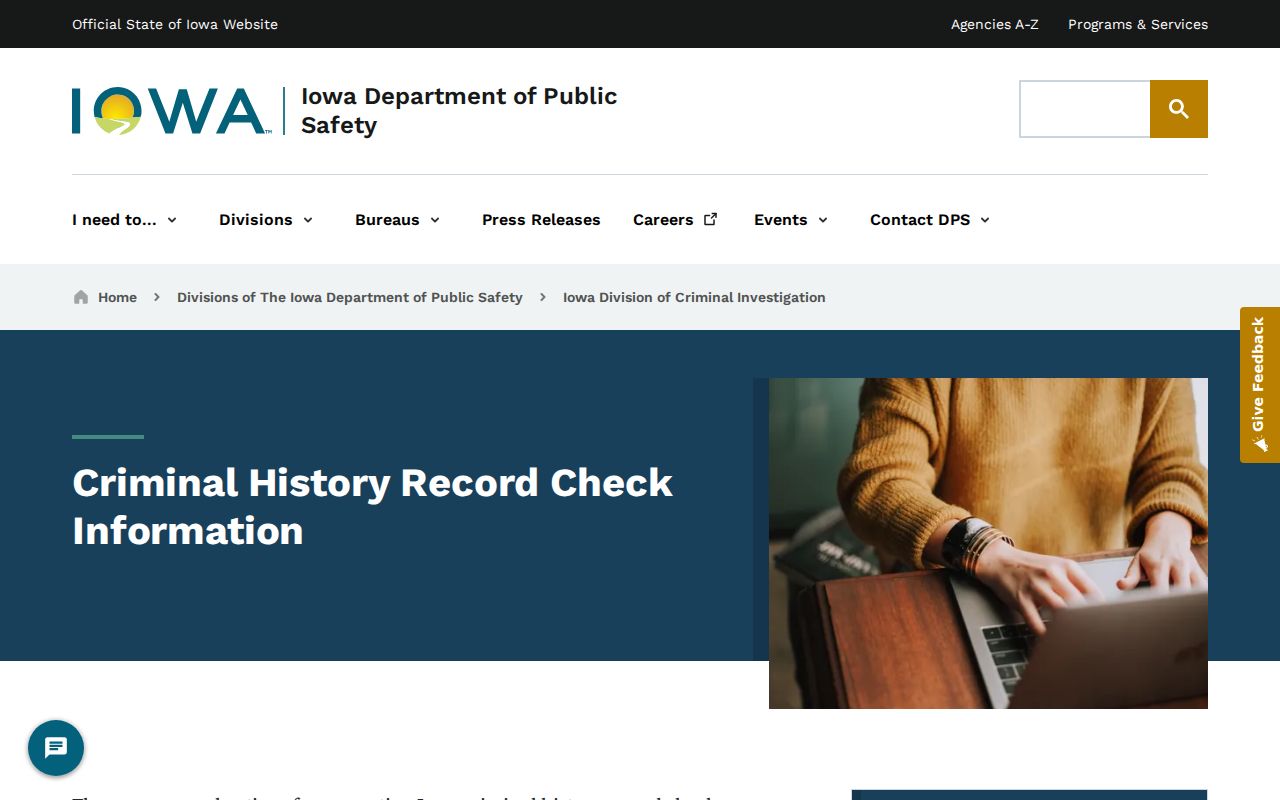
Follow DCI's current instructions because payment, delivery, and secure email steps belong to the state process.
Plymouth County Fingerprint Record Flow
Iowa's central record begins with fingerprints. After a qualifying custodial arrest, the arresting agency sends prints with identity and charge data to DCI. The county jail creates a separate intake file, the investigating agency keeps its own report, and the clerk later adds court events and dispositions to the statewide court system. Courts and justice agencies then report outcomes and custody changes back to DCI.
Record flow: Arresting agency › Plymouth County booking › County Attorney charging decision › District Court file › DCI disposition update.
A Plymouth County record gap can arise when prints were not taken, an agency has not reported, identity data do not align, or the final result has not reached DCI. A DCI “no record found” response may also reflect material that cannot be released to that requester. That is why a Plymouth County court case can appear in Iowa Courts Online yet not appear in a public DCI response.
Kinds of Criminal Records
Plymouth County record labels describe who created a file and what it can prove. An incident report preserves allegations and officer work. An arrest record shows a custody action. A booking entry documents jail intake. The court docket shows filed claims and judicial results. DCI assembles fingerprint-supported cycles under Iowa disclosure rules. Warrants and corrections records serve still different roles.
- Arrest and booking
- The agency action and jail intake, neither of which proves guilt.
- Court case file
- The clerk-held sequence of charges, hearings, orders, plea or trial, judgment, and sentence.
- Disposition
- The outcome of one charge, such as conviction, acquittal, dismissal, or another resolved status.
- DCI criminal history
- An Iowa fingerprint-backed record of reported arrest cycles and later events, subject to chapter 692.
- Custody and supervision
- County jail, state prison, probation, parole, work release, or community placement information held by different systems.
The same Plymouth County event can create several files. Read each for the fact it is built to show.
Plymouth County Records in Le Mars
Two Le Mars addresses hold different halves of many Plymouth County matters. The courthouse at 215 4th Avenue SE houses the Clerk of District Court, which keeps criminal case files. The Law Enforcement Center at 451 14th Avenue NE houses sheriff and corrections functions tied to custody, booking, warrants, and sheriff reports. Sending one broad request to “the county” can fail because each office has a separate duty.
Plymouth County Clerk
215 4th Ave SE
Le Mars, IA 51031
712-546-4215
Monday through Friday, 8:00 a.m. to 5:00 p.m.
Plymouth County Sheriff
451 14th Ave NE
Le Mars, IA 51031
712-546-8191
Civil administration weekdays, 8:00 a.m. to 4:30 p.m.
Plymouth County Attorney
215 4th Ave SE
Le Mars, IA 51031
712-546-5019
Files and handles prosecutions; not the certified-copy counter.
The official clerk page provides the courthouse contacts shown with this image.
The clerk is the offline fallback when a docket is old, unclear, archived, or missing a public document.
Plymouth County Criminal Records: What They Contain
A Plymouth County court entry centers on the case number, filing date, status, parties, charge counts, events, schedule, money entries, and disposition. A DCI response centers on identity and fingerprint-supported arrest cycles. A booking file focuses on intake and present custody. Public versions omit or restrict protected identifiers, juvenile information, victim data, and confidential material.
| Name and identifiers | Displayed fields used to distinguish a person; the exact set varies by system. |
|---|---|
| Arrest or booking data | Agency, date, initial charge or hold, booking event, bond, and release or custody status when public. |
| Charges and statutes | Separate counts, Iowa Code citations, level or class, and amended or dismissed status. |
| Disposition | The outcome of each count, which may differ within one case. |
| Sentence | Judgment terms, fine, costs, restitution, confinement, probation, or other orders when public. |
| Custody or supervision | County jail, IDOC prison, probation, parole, work release, or community placement status in the proper system. |
Do not infer a Plymouth County conviction from an arrest label. The final judgment and count-level disposition control that conclusion.
Plymouth County Current Jail Roster
The sheriff publishes a generated PDF marked “Current Only.” It is a snapshot of people held now, not a searchable archive of Plymouth County arrests. Its URL includes a dated or versioned path, so start at the sheriff homepage for the newest roster instead of saving one PDF link. Browser Find may help if the current PDF contains searchable text.
An older Plymouth County booking calls for another route. Ask the arresting agency for its arrest or incident report, ask the sheriff for historical booking material, and review the court docket if charges were filed. No county report fee or firm turnaround was published in the sources reviewed, so confirm scope, format, cost, and delivery before sending the request.
The Plymouth County Sheriff's Office supplies the stable path to current custody information and the source for this image.
The roster should never be read as a full arrest history or a final statement about guilt.
Iowa Public Access Laws
Plymouth County access starts with Iowa's right to inspect public records, but that right operates alongside laws that restrict criminal-history dissemination, juvenile files, personal data, investigations, and court records. Ask the agency that made the record. A chapter 22 request to the sheriff does not replace a request to the clerk for a Plymouth County court filing.
Key Iowa authorities:
Iowa Code §§22.2 and 22.7 grant public inspection rights while identifying confidential records and lawful exceptions.
Iowa Code §692.2 controls dissemination of DCI criminal-history data.
Iowa Code §901C.2 sets relief for qualifying acquittals and dismissals.
Iowa Court Rules chapter 16, division VI governs public electronic court access and protected personal information.
A “public” Plymouth County record is not always complete or unredacted, and it does not prove that an allegation was true.
Plymouth County Court Search Fields
Iowa Courts Online is the strongest first source for filed Plymouth County charges and outcomes. Choose Trial Court, select Plymouth County, and use an exact case number when known. Plymouth County name searches are useful but need care because spelling, middle names, and shared names can lead to the wrong file. Advanced Case Search requires registration and a paid subscription and advertises deeper scheduling, financial, exhibit, and party data.
| Search field | Use | Practical note |
|---|---|---|
| County | Select Plymouth | Narrows the statewide trial-court index |
| Last and first name | Find party matches | Confirm identity from case context |
| Middle name | Narrow a common name | May be absent from the file |
| Case number | Open a known matter | More exact than a name search |
| Case type and date | Advanced filtering | Some controls require paid Advanced access |
The official Iowa Courts Online entry is shown below.
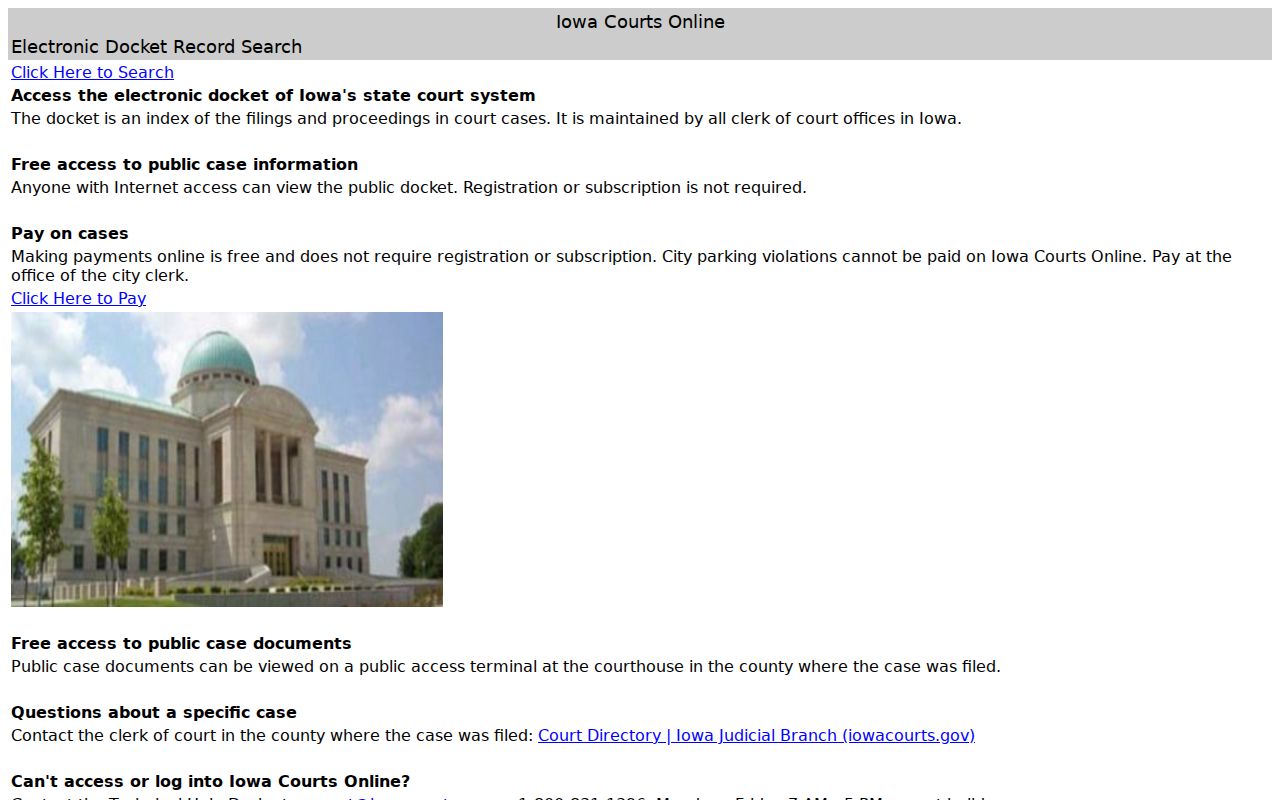
Docket text does not ensure that the underlying document can be downloaded; request a public copy from the clerk when needed.
Restricted, Sealed & Expunged Records
Plymouth County expungement requests use Iowa's statute-specific remedies rather than one broad sealing rule. Section 901C.2 may apply to qualifying acquittals or dismissed charges. Section 901C.3 provides limited relief for certain misdemeanor convictions, with exclusions and a waiting period. Section 907.9 deals with discharge and court-record expungement after a deferred judgment. Juvenile records follow separate confidentiality rules.
Start with the exact Plymouth County case number and disposition. Match that outcome to the correct statute, check debt and waiting-period conditions, obtain the current Iowa Judicial Branch form, and file with the Plymouth County Clerk. The research did not locate a current local filing or copy fee, so ask the clerk before filing.
A key trap remains after Plymouth County relief. DCI states that a completed deferred judgment may be expunged at the court level yet remain in its repository as a discharged nonconviction. After an order, confirm both the court view and a personal DCI history rather than assuming every government trace was erased.
Plymouth County and Iowa Custody
The Plymouth County roster covers present local custody. Iowa Offender Search covers people in state prison, community-based programs, probation, parole, and work release. It can be searched with name details, date-of-birth ranges, sex, offender number, location, or county of commitment. Neither Plymouth County nor state custody data substitutes for the judgment that explains why supervision exists.
The Iowa offender-search guide explains those state fields and supplied this image.
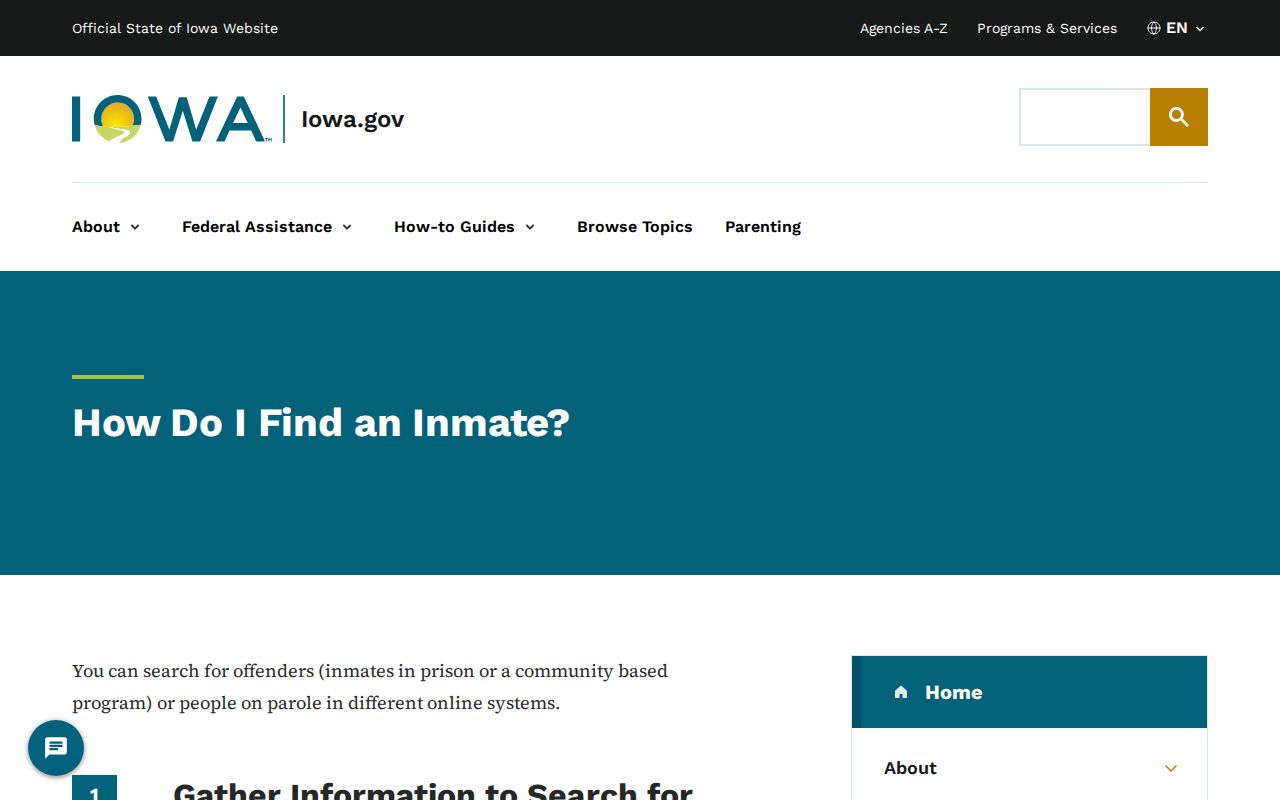
Use the sheriff for a person held in Le Mars and IDOC only after the record points to state custody or supervision.
Plymouth County Registry Records
The Iowa Sex Offender Registry is a public-notification system, not a general criminal-history database. Its 2025 redesign added broader search tools, active and most-wanted links, and interactive area maps. A Plymouth County search may use county, city, ZIP code, name, or map controls. The state uses chapter 692A offense categories and duties, including ten-year and lifetime registration in the circumstances set by law. It does not use a simple public low, medium, and high score that can be borrowed from another state.
The official Iowa Sex Offender Registry is the source for the interface pictured here.
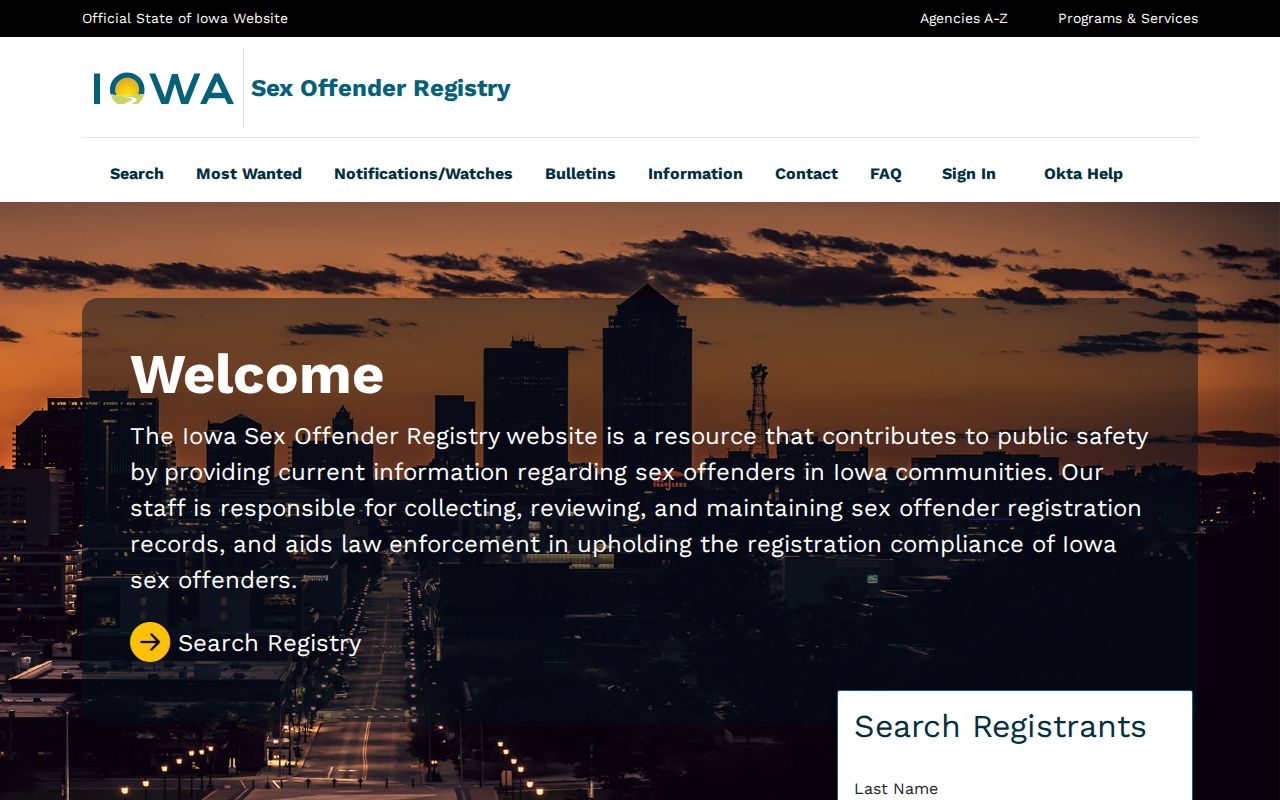
Use registry information for lawful safety awareness, verify details at the official source, and never confront or harass a listed person.
Plymouth County Charging Records
The Plymouth County Attorney represents Iowa and the county in criminal proceedings. That office decides what state charges to prosecute and files the formal charging path, but the Clerk of District Court maintains the case file. This split matters when a reader wants a trial information, judgment, or certified copy. The prosecutor can address duties within legal and confidentiality limits; the clerk is the records counter.
The official Plymouth County Attorney page documents the office's role and is the source for this image.
Once a case is filed, the docket and court orders provide the best public trail of what happened to each charge.
City-by-City Criminal Records in Plymouth County
Le Mars, Akron, and Remsen are the three incorporated cities identified in the research ranking. City location helps determine which agency created an incident report, but filed criminal and ordinance matters use Iowa's unified District Court system. Le Mars has a verified municipal police source. Akron requires confirmation of the investigating agency. Remsen's official city law-enforcement source was not validated, so its route begins with county and state custodians rather than an invented local desk.
Le Mars Record Check
Start with Le Mars Police for its report, then use the sheriff, clerk, or state system for the next record.
Akron Record Check
Identify the investigating agency before requesting a report; court and county custody records route through Le Mars.
Remsen Record Check
Use Plymouth County court, sheriff, and state tools while confirming the local report custodian.
These city routes preserve the difference between an agency report, a county booking, a court result, and a state record.