
Criminal Court Cases in Plymouth County
Plymouth County does not divide criminal filings between a district clerk, a county clerk, and a city court. The Plymouth County Clerk of District Court maintains one Iowa District Court file system for felony, misdemeanor, traffic, and other state trial matters. The court sits in Judicial District 3. City citations also enter this unified system because Iowa abolished municipal courts with separate criminal dockets.
The clerk's case file is the main source for how a Plymouth County charge ended. It can distinguish a filed count from an arrest allegation, show that one count was amended while another was dismissed, and identify a plea, verdict, judgment, or sentence. Appellate matters proceed through the Iowa Court of Appeals or Supreme Court. Federal prosecutions from Plymouth County belong to the U.S. District Court for the Northern District of Iowa and are not found in the state trial-court search.
Plymouth County's Unified Court File
A single criminal episode can produce several records, but they do not serve the same role. The arresting agency keeps its report. The jail keeps booking and custody data. The Plymouth County Attorney decides which state charges to prosecute, while the clerk opens and maintains the judicial file. That division explains why a broad request to “the county” may not reach the right custodian.
Ask the Plymouth County clerk for docket entries, filed charging papers when public, orders, judgments, sentences, financial entries, and certified copies. Ask the arresting agency for its narrative or incident report. A DCI response is a third product: a statewide fingerprint-backed history governed by Iowa dissemination rules. Readers tracing the full event can use the broader Plymouth County criminal history overview to keep those sources separate.
Record flow: Arrest or summons › County Attorney charging decision › Clerk opens court file › Hearings and orders › Disposition and sentence › Reported updates to DCI.
Plymouth County Case Record Searches
Iowa Courts Online Electronic Docket Record Search is the first public route for filed Plymouth County cases. The basic trial-court search is free. A known case number is the best key; otherwise, use a name and confirm the result through county, case details, and dates. A name match alone is not identity proof.
- Open the trial-court search and select Plymouth County.
- Enter the exact case number when known, or use the last and first names.
- Review each possible match and confirm the county, filing context, and case type.
- Open the case summary, read every count, and follow the newest disposition and judgment entries.
- Call or visit the Plymouth County clerk for a missing public filing, an archive question, or a plain or certified copy.
| Field Label | Type | Required | Options or Notes |
|---|---|---|---|
| Search Type / Trial Court | Navigation | Yes | Choose trial rather than appellate search |
| County | Dropdown | For local narrowing | Select Plymouth |
| Last / Business Name | Text | Conditional | Spelling matters; try known variants |
| First / Middle Name | Text | Optional | Helps narrow common surnames |
| Case Number | Text | Alternative | Use the Iowa case-number format |
| Case Type / Date | Advanced controls | Optional | Subscription search features |
Plymouth County Basic and Advanced Dockets
The free public view is the ordinary place to begin. Iowa's Advanced Case Search requires registration and a paid subscription. It advertises added party detail, judgments and liens, exhibits, fuller financial data, service returns, traffic data, case-type and schedule searches, and clerk-entered information as it is entered. It does not replace the separate court-payment service.
The official Advanced Case Search login shows the deeper access route used for Plymouth County dockets.
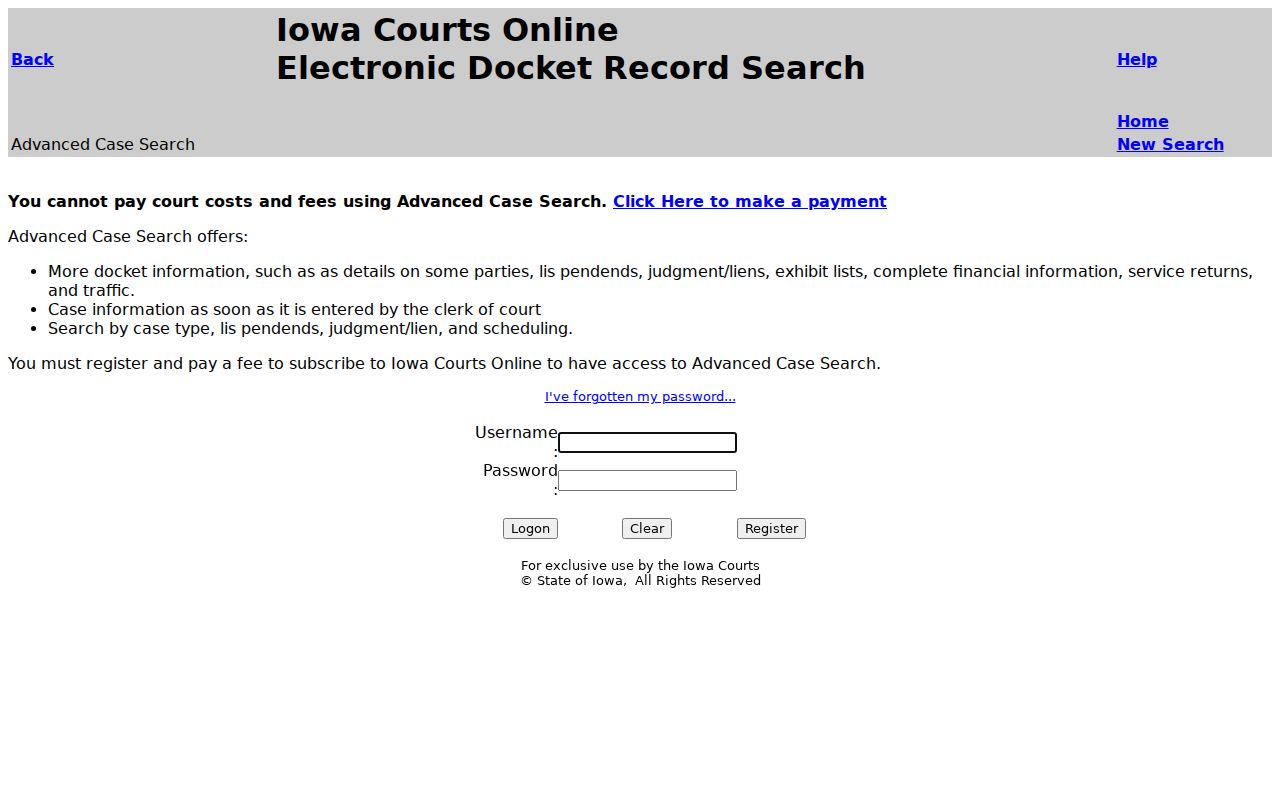
The image helps readers recognize the official Iowa Judicial Branch entry before entering account details. Even advanced docket text does not guarantee that each underlying PDF can be downloaded. When a needed public document is absent, note its docket date and description, then ask the Plymouth County clerk for a copy.
Case numbers also beat name searches when two people share a name or spelling varies. Ask the clerk to confirm the number from known public context rather than assuming the first result belongs to the person sought.
What a Criminal Case File Contains
A Plymouth County court file is organized around a case and its separate charge counts. The header identifies the county, case number, type, filing date, and status. Party and attorney entries show who appears in the case. Charge lines may list an offense description, statute, level, and whether the count was changed or dismissed. Docket events then form the public chronology.
| Case Number & Court | Identifies the Plymouth County case, trial court, type, filing date, and status. |
|---|---|
| Charging Document | Shows the complaint, trial information, or other filed accusation when public. |
| Docket Entries | Lists filings, appearances, pleas, motions, orders, warrants, and later events. |
| Hearing Dates | Gives scheduled event details, courtroom, or judge when entered. |
| Disposition & Judgment | Records the result of each count and the court's judgment. |
| Sentence & Conditions | May show confinement, probation, fines, costs, restitution, and public conditions. |
Financial entries can include fines, surcharges, costs, restitution, and other public assessments. Restricted identifiers and confidential material are removed. Docket text is an index and chronology, not a promise that the full motion, exhibit, or order is freely viewable online.
Reading Plymouth County Amended Charges
The charge shown at arrest may not match the charge that reaches judgment. A prosecutor may file a different offense, amend its class, dismiss one count, or resolve another through a plea. Read every count in a Plymouth County case separately. Then locate the last disposition and judgment tied to that count.
- Trial information
- Iowa's formal charging instrument for an indictable offense.
- Disposition
- The outcome of a particular charge or case, such as dismissal, acquittal, or conviction.
- Deferred judgment
- An Iowa process that withholds judgment while court-set terms are completed.
- Revocation
- A later proceeding that may withdraw probation after an alleged violation.
A dismissed count does not turn a separate convicted count into a dismissal. Likewise, a completed deferred judgment may be expunged at the court level while DCI retains an updated nonconviction entry subject to Iowa release law. The source and the date of each result matter.
Criminal Case Stages in Plymouth County
An arrest or summons may lead to a prompt initial appearance, where the court addresses identity, rights, counsel, and release. The prosecution then proceeds by complaint, trial information, or indictment as the law allows. At arraignment, the charge is read or waived and a plea is entered. Discovery and motions follow. The case may end by dismissal, negotiated plea, or trial.
Case flow: Charges Filed › Arraignment › Pretrial › Plea or Trial › Disposition › Sentencing
Judgment and sentence are the key interpretation points in a Plymouth County docket. Appeals, probation reviews, revocation proceedings, or a later expungement request can add entries long after the first result. Always check the latest event rather than stopping at the first charge or hearing.
Plymouth County Clerk Copy Requests
The clerk counter is the direct fallback for an older, archived, incomplete, or unclear Plymouth County result. Bring the case number if possible. Ask whether the desired filing is public, whether it is electronic or archived, and whether a plain copy will meet the need. A certified copy carries the clerk's formal certification, but no current local copy fee was found in the official sources reviewed.
Plymouth County Clerk of District Court
215 4th Avenue SE
Le Mars, IA 51031
712-546-4215
Monday through Friday, 8:00 a.m. to 5:00 p.m., excluding listed judicial holidays.
The clerk can explain record access and provide forms or procedure, but cannot give legal advice. For prosecution or victim and witness functions, Plymouth County uses the title County Attorney. That office is not the records clerk and should not be the first stop for certified case copies.
Note: Call before travel when an archive pull, accommodation, or specific certified record is needed.
Plymouth County Docket Class Labels
Iowa District Court hears felony and misdemeanor cases in Plymouth County. The docket's class label helps describe the filed offense, but offense-specific law, enhancements, and later amendments can change the practical result. Class A through D felonies appear under Iowa Code chapter 902. Aggravated, serious, and simple misdemeanors are addressed by chapter 903.
The official current Iowa Code is the source for the law in force when interpreting Plymouth County charges.
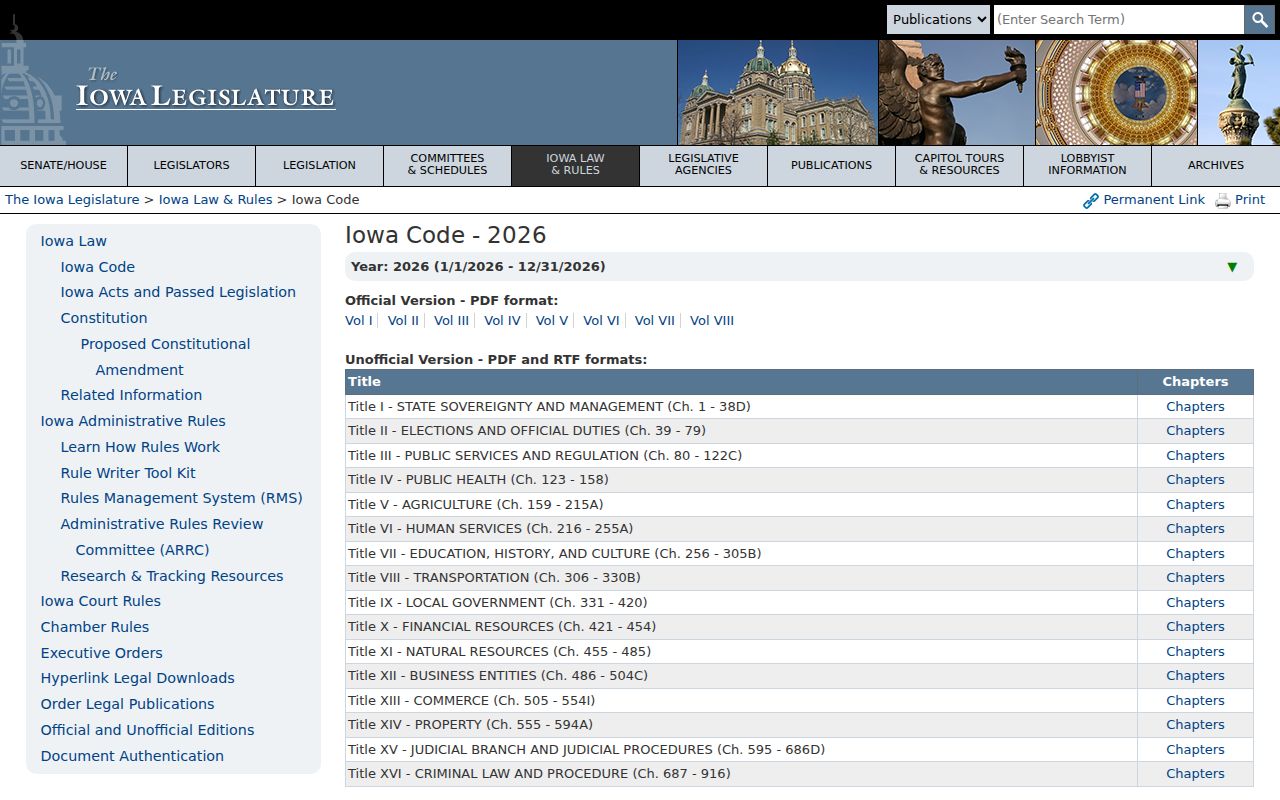
This official code view matters because scheduled fines and offense rules can change. Do not infer the final conviction class from a booking label. Use the filed and amended counts, then read the judgment that controls the Plymouth County outcome.
Access Rules for Case Records
Iowa court records begin with a presumption of public access, but that does not make every Plymouth County filing fully visible. Iowa Court Rules chapter 16, division VI governs electronic court access and restricted personal data. Juvenile court records are generally confidential under Iowa law. Sealed or expunged matters, protected victim details, Social Security numbers, financial-account data, and other restricted information may be withheld or redacted.
Public access has limits: Iowa Code chapter 22 sets the general public-records framework, while court rules and specific confidentiality laws control access to judicial files.
If a Plymouth County case does not appear, do not assume it never existed or was cleared. The name may differ, the file may be archived, an entry may be restricted, or the search may be incomplete. Contact the clerk with the case number and ask what public access is available. For the outcome of a prosecution, the court judgment is more reliable than an arrest entry or an old charge description.
A chapter 22 request to the sheriff is not a substitute for a request to the court custodian. Route Plymouth County judicial documents to the clerk, even when the same event also produced an incident report or jail record. This keeps the request tied to the office that created and maintains the file.